
At the "Besat-e Khoon" (Mission of Blood) symposium, held at the University of Kurdistan to commemorate the 40th day of the martyrdom of the Leader of the Ummah, Ayatollah Sayyid Ali Khamenei (RA), various dimensions of national and regional developments were analyzed.
Israel’s Hostility Toward Iran Stemming from National Economic and Military Independence
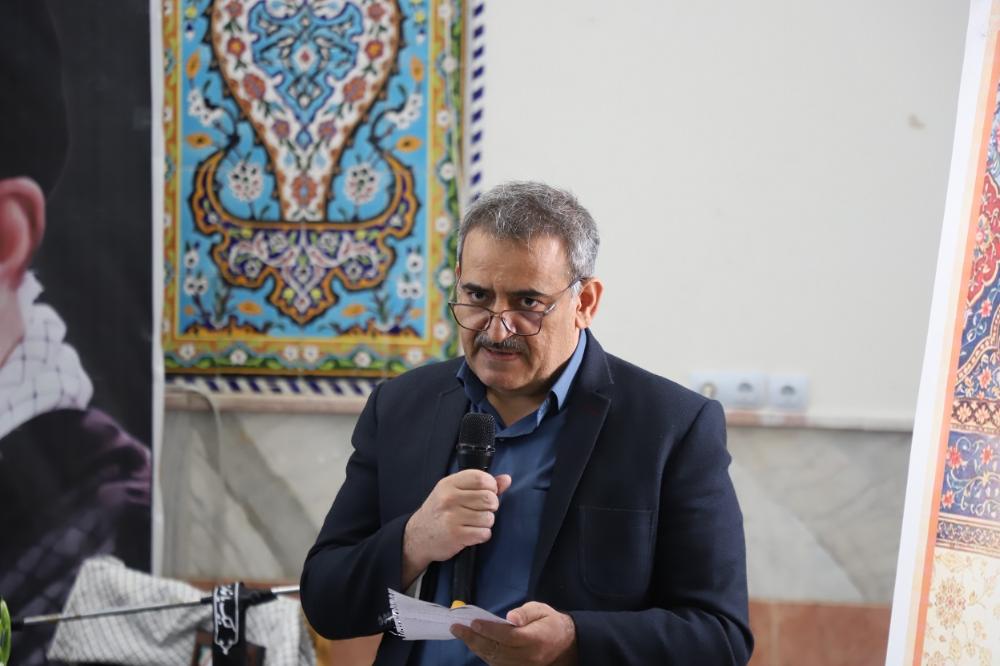



According to the University of Kurdistan Public Relations; Dr. Adel Sive-se-marde, speaking on Saturday, April 11, at the gathering held in the Prophet Azam (PBUH) Mosque, expressed his condolences and deep sorrow regarding this painful loss. He remarked: "While we and much of the world recognize the unparalleled religious and spiritual character of our martyred leader, we must not overlook his national significance. It is essential that future academic discourse, particularly within universities, explores this dimension further, as it plays a vital role in fostering national solidarity."
He added: "Israel’s animosity toward Islamic Iran is not solely due to its Islamic identity; it is equally driven by opposition to the nation’s economic and military sovereignty." Dr. Sive-se-marde continued: "If the current Islamic system were to step aside today, Israel would undoubtedly launch the most severe attacks against our economic and military infrastructure tomorrow. The existence of a militarily and economically independent nation in the Middle East is utterly unacceptable to the Zionists."
Reflecting on the consequences of the recent conflict, the University President noted: "We must acknowledge that this war has inflicted significant human and financial costs. However, it also exposed our technical vulnerabilities, such as air defense, while highlighting our strengths, such as missile capabilities. Therefore, we must exert greater effort to rectify weaknesses and bolster our strengths immediately." He further asserted that Israel has spent years attempting to draw the United States into a war with Iran, noting that they found an ideal accomplice in Donald Trump due to his moral vulnerabilities related to the Epstein case, which he alleged are leveraged by Netanyahu.
Emphasizing the role of science in modern warfare, he added: "The 12-day war and the Ramadan War demonstrated that while courage and faith are essential, scientific capability is a primary pillar of combat. We must prioritize the nation’s research and development sector." He lamented that the national share of research has dwindled to less than 0.7%, a figure he described as meager even by the standards of developing nations. He concluded: "Sooner or later, this war and these negotiations will end. The ultimate victors are the people who endure these hardships with dignity and resilience."
The Enemy has Failed in Its Objectives, Including the Partition of Iran
The Representative of the Supreme Leader at the University of Kurdistan stated that the enemy has failed in its attempts at regime change and territorial partition, noting that plots to divide Iran along ethnic lines have not materialized.
Hojjat-ol-Islam wal-Muslimin Abedin Rostami, commemorating the martyrs of the war, the revolution, and the martyred leader, stated: "In an environment ostensibly based on negotiation, the enemy attacked our country for a second time using the same flawed logic, resulting in the martyrdom of our leader, the highest executive official of the land." He noted that the Leader stood courageously with the people and for the faith. "The enemy believed that with his martyrdom, the country would collapse. However, the Islamic Republic is a robust structure; while a window may break or a facade may fall, its foundations are unshakable and grow stronger daily."
Hojjat-ol-Islam Rostami continued: "The enemy’s strategic error was the assumption that decapitating the system would lead to its collapse. Instead, the blood of our martyred leader and the martyred students of Minab has surged through the veins of the nation, propelling this system with immense power." He identified four current battlefields: public presence (the most powerful field), the military field (where only 15% of missile and deterrent capacity has been utilized), the field of service (where the government has fostered social calm), and the field of diplomacy.
Regarding diplomacy, he stated: "In the thought of the leaders of the Revolution, diplomacy is a tool for Jihad, not compromise. If it leads to concession, it mirrors the diplomacy of the Qajar or Pahlavi eras. Diplomacy must be defined alongside resistance." He emphasized that the ten conditions set for negotiations are the basis for talks, not merely ceasefire terms. He concluded by stating that the public no longer trusts the "enemy's signature" and views the power of the people and the armed forces as the only true guarantee, asserting that the nation’s faith and domestic strength have neutralized all plots for partition and overthrow.


Quick Links
Electronic Services
Useful Links


University of Kurdistan, Pasdaran Boulevard, Sanandaj, Iran

Postal Code: 6617715175

Phone: +988733664600-8

Email: info@uok.ac.ir


site visit
- today:
- yesterday:
- all:
Last Update
20 Apr 2026 - 10:19:48